
Launch readiness is more than operational readiness
For many biotech organisations, the concept of launch readiness is closely associated with operational readiness. Leadership teams typically focus on whether manufacturing capacity is secured, supply chains are stable, systems are in place, and the necessary commercial resource has been recruited. These are essential considerations and, without them, a launch will not succeed.
However, operational readiness represents only one dimension of what it means to be truly prepared for commercialisation.
As organisations approach launch, the nature of their operating environment fundamentally changes. Their activities become more visible, the volume and complexity of interactions externally increase, and the expectations of regulators, partners, and other stakeholders change, mainly raising the bar. In this context, the challenges that emerge are rarely confined to operational delivery. More often, they relate to how the organisation makes decisions, manages risk, and behaves under pressure.
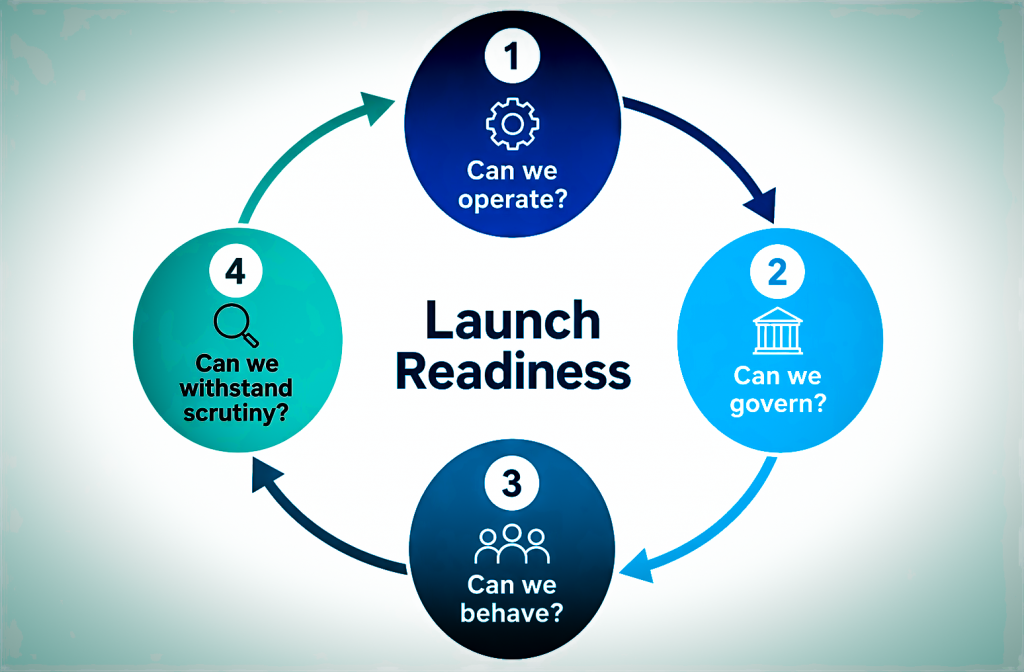
A more complete view of launch readiness can therefore be considered through four interconnected questions, as outlined below.
Can we operate?
Operational strength remains the foundation of any successful launch. Organisations must be able to deliver product reliably, supported by appropriate infrastructure, systems, and people. In other words, the supply chain needs to work. At this stage in their lifecycle, most biotechs have already invested significant effort in building these capabilities, and in many cases, they are well developed.
The transition to commercialisation, however, places additional strain on these systems. Processes that functioned effectively in a lower-volume, internally focused environment are required to operate at greater scale and across a broader set of stakeholders. The organisation’s footprint expands rapidly to include external partners such as agencies, distributors, and service providers, all of whom become integral to delivery.
This expansion exposes areas where operating models may lack the required level of coherence. Documentation can become inconsistent across functions, processes may not align, and ownership of activities may be unclear. These issues are not always apparent in earlier stages but can become more evident as activity increases and the model is challenged.
Operational readiness, therefore, is not simply a question of whether capabilities exist, but whether they function as an integrated system that can withstand the pace and complexity of product launch conditions. Organisations need to demonstrate control, namely the ability to ensure that decisions are made as intended, actions are carried out consistently, and outcomes are understood, evidenced, and defensible.
Can we govern?
Beyond operations, effective governance is critical in ensuring that the organisation can make timely and well-informed decisions.
Governance is often associated with formal structures such as committees, reporting processes, and approval forums. While these elements are important, their value lies in how well they support decision-making in practice. As launch approaches, decisions become more frequent, more complex, and they have more consequences. They are rarely confined to a single function and often involve trade-offs between speed to market, risk, and long-term value.
In this context, clarity becomes essential. Organisations benefit from having defined decision frameworks that specify who is responsible for making particular judgements, how evidence is considered during the decision-making process, and when escalation is required. This is particularly important in the grey areas where guidance is not black and white and interpretation is required.
Where such clarity is absent, decisions may be delayed, revisited (and changed) repeatedly, or made informally without adequate documentation. Over time, this can lead to further inconsistency, inefficiency, and increased exposure.
The purpose of strong governance frameworks is to enable decisions to be made more efficiently by providing structure, accountability, and transparency. Trade-offs need to be visible and understood. Better decisions lead to less rework and fewer surprises.
Can we behave?
The third dimension of launch readiness is often less tangible but equally important. It relates to how individuals and teams behave when faced with competing priorities.
As organisations move closer to launch, the pressure to deliver increases. Positive clinical data, raised investor expectations, commercial ambition, and the desire to help patients can create a strong drive to accelerate activity. In this environment, individuals are frequently required to make judgements in situations that are not clearly defined by rules or procedures.
This is particularly evident in areas such as the interaction between medical and commercial functions, or in early external engagement activities. Without clear role definition and a shared understanding of boundaries, there is a risk that decisions are made inconsistently or based on incomplete perspectives. Or decisions default to what works in the short term without considering the longer term implications.
Training and policies play a role in preparing teams, but they are not sufficient on their own. Culture and incentives influence how individuals respond in practice. If leaders prioritise speed to market above all else, or if raising concerns is perceived as a barrier to progress, then behaviours will reflect those signals, including taking shortcuts or adopting workarounds.
Organisations that navigate this effectively tend to invest in building judgement, not just awareness. They encourage early escalation of issues, reinforce accountability, and create an environment where individuals feel able to challenge and seek clarity when needed.
Can we withstand scrutiny
The final dimension of launch readiness is the ability to withstand external scrutiny.
As the organisation’s activities become more visible, they are subject to greater examination by regulators, competitors, partners, and, in some cases, the public. This scrutiny does not begin at the point of formal launch; it often increases as soon as the organisation begins to engage more actively with the external environment, much earlier than many organisations expect.
In this context, stakeholder expectations extend beyond the existence of policies and procedures. Increasingly, they look for evidence that controls are operating effectively and consistently in practice. This includes the ability to demonstrate how decisions were made, how interactions were managed, and how data has been captured, classified, and reported.
Consistency across functions is also important. External stakeholders assess the organisation as a whole, rather than as a collection of separate teams. Misalignment in messaging or approach can quickly undermine credibility.
Ultimately, the responsibility for responding to scrutiny sits with leadership. This is not a question of achieving perfection, but of ensuring that decisions are considered, documented, and defensible.
A broader view of readiness
Operational preparedness remains a critical component of launch readiness, but it does not, in isolation, determine success.
A more comprehensive perspective recognises that organisations must be able not only to deliver, but also to govern effectively, behave consistently, and demonstrate control under scrutiny. These elements are closely interconnected, and weaknesses in one area can quickly affect others.
For leadership teams, this requires a shift in emphasis. Launch readiness is not simply the completion of a series of operational milestones. It is a reflection of how the organisation functions as a whole, particularly when operating at pace and under increased visibility.
Considering readiness through the lenses of operating capability, governance, behaviour, and scrutiny can help to identify potential gaps earlier and support more informed decision-making as the organisation prepares for this transition.
How GRC Catalyst can help
GRC Catalyst supports launch readiness by helping biotech leaders move beyond operational preparedness and build an organisation that can operate, govern, behave, and withstand scrutiny in practice.
Drawing on deep healthcare compliance expertise, GRC Catalyst works with leadership teams to design and embed governance, risk, and compliance frameworks that are proportionate, integrated, and aligned to the realities of scaling from R&D to commercialisation.
This includes clarifying decision rights and accountability, strengthening controls and oversight, developing scenario-based training to build judgement under pressure, and ensuring that systems and data support credible reporting and transparency.
The focus is not on adding complexity, but on creating practical, usable frameworks that enable confident decision-making, support ethical behaviour, and provide clear evidence that the organisation is in control as it enters the launch phase.
Disclosure
The concepts and ideas in this article are mine or have been referenced; I developed the body of the text and conducted the final editorial check. I used AI as a tool for research, to improve the flow and grammar of the article, and to check for factual inaccuracies.