Integrated GRC: Driving Principled Performance and Strategic Agility
While most business leaders recognise Governance, Risk, and Compliance (GRC) as individual corporate necessities, few realise their true potential when they are integrated into an effective operating model. Instead of being a reactive, tick-box exercise, an integrated GRC framework acts as a unified operating system, an umbrella under which distinct capabilities converge to protect value, accelerate decision-making, and drive strategic objectives.
First coined over 20 years ago by the Open Compliance and Ethics Group (OCEG), an integrated GRC framework replaces disjointed, siloed workflows with what they term “Principled Performance” – the ability to reliably achieve objectives while addressing uncertainty and acting with integrity.
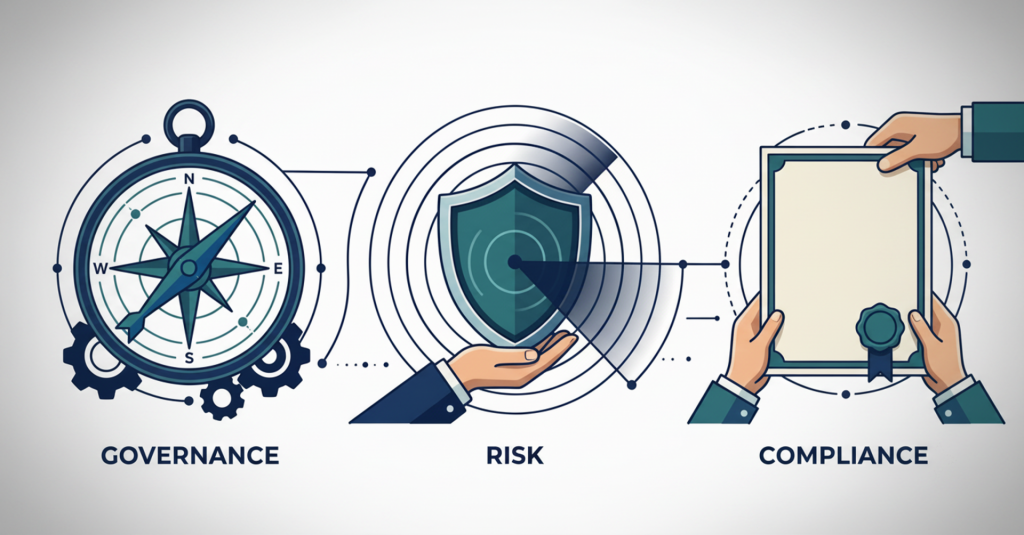
To understand the power of GRC, we must look at how its three core pillars intersect:
- Governance (The Compass): This establishes the decision-making frameworks, leadership structures, and accountability rules. It ensures that everyday corporate actions remain strictly aligned with organisational values and long-term strategy.
- Risk Management (The Shield & Radar): Rather than just avoiding downsides, modern risk management identifies, assesses, and mitigates threats (such as cyberattacks or financial losses) while simultaneously scanning the horizon to capture upside opportunities.
- Compliance (The License to Operate): This guarantees adherence to external laws (like GDPR or industry-specific regulations) and internal codes of conduct, building foundational trust with stakeholders and regulators alike.
In practice, this means leadership teams can make faster calls on product launch timelines, third-party engagement, or market expansion because risk, compliance, and strategy are considered together, not sequentially.
And, for boards, integrated GRC provides not just assurance, but visibility, connecting strategy, risk exposure, and control effectiveness in a way that supports oversight.
The Five Dimensions of Modern GRC
An effective GRC framework is not a static document; it is a dynamic ecosystem characterised by five core traits:
- Strategic: It rises above a focus on risk avoidance to act as a growth enabler, giving leadership the confidence to innovate and capitalise on market shifts.
- Cultural: It embeds accountability and integrity directly into the organisation’s DNA, guiding how employees think, decide, and behave daily.
- Evolving: It flexes to outpace global complexities, technological disruptions, and market shifts.
- Inclusive: Built on a foundation of ethical leadership and psychological safety, it fosters an environment where employees feel empowered to speak up.
- Scalable: It is entirely customisable, flexing seamlessly to fit the operational reality of a lean startup or a multinational corporation.
Importantly, integrated GRC must be right-sized, avoiding over-engineered controls that slow growth, while ensuring sufficient structure to support commercial scale and regulatory scrutiny.
Future-Proofing GRC: Navigating the Modern Enterprise Landscape
As the business environment grows more complex, traditional GRC boundaries need to expand in response. To maintain resilience, a modern GRC framework now incorporates four critical, future-proofing pillars:
- AI Governance and Ethics
With the rapid enterprise adoption of Artificial Intelligence (AI) and automated systems, organisations face unprecedented risks regarding data lineage, algorithmic bias, and intellectual property. A future-proof GRC model establishes strict guardrails around ethical AI deployment, ensuring alignment with emerging global frameworks (such as the EU AI Act) while supporting safe technological innovation.
- ESG (Environmental, Social, and Governance) Integration
ESG is no longer just a corporate social responsibility initiative; it is an essential component of compliance and risk. Integrating ESG criteria directly into the GRC framework ensures that sustainability metrics, climate risks, carbon accounting, and social impact data are monitored, audited, and reported with the same rigor as traditional financial data.
- Third-Party and Supply Chain Risk Management (TPRM)
Modern businesses rely heavily on a vast network of vendors, cloud providers, and global supply chains, meaning a company’s risk profile is only as strong as its weakest partner. Expanding GRC to encompass TPRM allows organisations to continuously vet, monitor, and audit third-party compliance, protecting the enterprise from upstream vulnerabilities and operational disruptions.
- Technology and Automation
The era of managing compliance via manual spreadsheets is ending. Incorporating technology enables automated compliance workflows, Continuous Control Monitoring (CCM), and predictive risk analytics. Leveraging automation drastically reduces human error, reduces administrative overhead, and provides leadership with real-time risk dashboards.
The Concrete Benefits of an Integrated GRC Approach
When organisations move away from managing governance, risk, and compliance in silos, they unlock significant operational and financial advantages:
- Breaking Down Silos and Eliminating Redundancy: Siloed departments often run duplicate risk assessments or overlapping compliance audits. An integrated approach unifies data collection, reducing administrative fatigue and cutting operational costs.
- Data-Driven, Confident Decision Making: By pairing risk metrics directly with strategic governance, executives gain real-time, holistic visibility into the business. This allows leadership to take calculated, bolder risks with greater confidence.
- Enhanced Agility and Regulatory Resilience: In a rapidly changing regulatory environment, an integrated GRC framework allows organisations to pivot quickly. New laws can be mapped directly to existing internal controls, preventing costly penalties, litigation, and downtime.
- Stronger Brand Equity and Stakeholder Trust: Demonstrating a rigorous, ethical framework increases investor confidence, protects company reputation during crises, and attracts customers who prioritise doing business with ethical partners.
- Proactive Opportunity Management: Because risk management in a GRC model focuses on the “upside of risk,” businesses become better at identifying market gaps, shifts in consumer behaviour, and technological advancements ahead of competitors.
Integrated GRC is about enabling better decisions, not building a better framework. When done well, it gives leadership the confidence to move faster, take smarter risks, and grow with integrity.
How GRC Catalyst can help
GRC Catalyst supports organisations to integrate governance, risk, and compliance by embedding these capabilities directly into day‑to‑day operations, moving beyond siloed frameworks to a cohesive, decision‑enabling model.
Drawing on deep healthcare compliance expertise, GRC Catalyst designs tailored, scalable GRC approaches that align with organisational strategy, risk profile, and stage of growth, ensuring controls are right‑sized and practical rather than overly complex.
By translating complex regulations into clear, actionable processes and tools, GRC Catalyst helps leadership teams strengthen resilience, enhance oversight, and integrate GRC as a true business enabler rather than a compliance burden.
Disclosure
The concepts and ideas in this article are mine or have been referenced; I developed the body of the text and conducted the final editorial check. I used AI as a tool for research, to improve the flow and grammar of the article, and to check for factual inaccuracies.